

Which is the best month to visit Masai Mara?
Which is the best month to visit Masai Mara? : South-western Kenya’s Masai Mara National Reserve is a remarkable wilderness tourist destination with year-round animal watching and a perfect temperature. The evenings on Kenya safari tours are significantly colder than the average midday temperature, which is nevertheless rather acceptable. June through August sees average daytime temperatures of about 77 F (25 C), with average nightly lows of about 50 F (10 C). From September through May, the average daily temperature ranges from 79 F (26 C) to 82 F (28 C), while the average night time low is 55 F (13 C). The Mara provides twelve hours or more of daylight for all of your outdoor Kenya safari activities in Africa. Although the year-round game viewing is exceptional due to these conditions, Kenya safari tours cautions visitors about weather patterns that could affect their time of year of choice when visiting the reserve.
Masai Mara National Reserve experiences two dry seasons and two rainy seasons, just like other parts of Kenya. Rainfall has an impact on water sources and vegetation, which in turn impacts Kenya safaris, animal migration and concentration. In times of scarcity, animals moves from the deep interior to more accessible regions in pursuit of sustenance. They also congregate around permanent or last-remaining water sources, such as the Mara and Talek Rivers.
Which is the best month to visit Masai Mara? : July to October, this is the best time of year to see safari game in the Mara because there is more wildlife visibility and less tracking time required. Furthermore, rainy weather negatively affects the state of the roads and trails since the black cotton soil welcomes cars during the rainy season. The majority of people agree that the extended cool-dry season, which runs from July to October, is the most expensive time of year to visit Masai Mara. Since there hasn’t been any rain, there is less greenery, making it simpler to view animals. Insect populations, particularly mosquito populations, are also reduced during the dry season Which is the best month to visit Masai Mara.
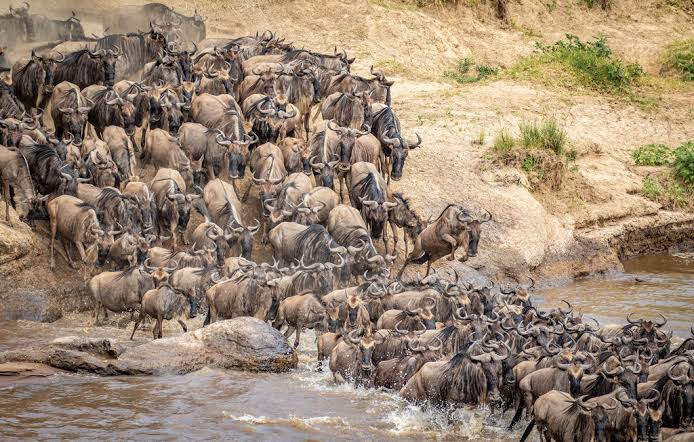
The Great Migration, which originates in the Serengeti National Park and reaches in Masai Mara during the extended dry season During this time there are a lot of Migration tour safaris along the migration route. In the reserve, the crocodile-infested Mara River is crossed by hundreds of thousands of zebras, elands, and gazelles in addition to an estimated 1.5 million wildebeests in search of water and food. The herds often come in late July, early August, and sometimes even early September, however exact dates of arrival vary from year to year.
The road conditions are ideal for wildlife watching, enabling you to get up close and personal with large herds of gnus and other terrestrial species. Predators are actively searching for their next meal because there are a lot of prey animals scattered across the reserve. Once the wildebeests have crossed over, the riverbank provides the easiest catch for them. A baby gazelle, an impala, or similar small mammal could be one of their most sought-after prey items for feline cubs practising their hunting skills.
There are certain drawbacks to the extended dry season in the Mara. You may notice more safari vehicles and signs of human presence than at other times of the year because this is the peak season for international tourist arrivals, including Kenya safari tours guests. However, since the Masai Mara has opened to private conservancies, the impact is mitigated but not eliminated because visitor and vehicle numbers are restricted in these regulated, low-ratio areas. The brief rainy season occurs between November and December.
On kenya safari tours apart from the periods around Christmas, New Year’s, and the first part of January, visitor numbers usually decrease during these months. An increasing number of animals go somewhat further inland into the bush and forest wilderness as a result of the rains, which revitalise the plains by bringing fresh water and food sources. The state of the roads in equatorial Kenya is still fair because the wetness is evaporating fast.
Why Maasai Mara is the Best
Masai Mara National Reserve, one of Africa’s greatest predatory wildlife density regions, is regarded as Kenya’s best park, offering breath taking plains beauty, unparalleled Kenya safari activities, and a broad range of species. Situated in southwest Kenya, the reserve has 583 square miles (1510 square km) of exceptional nature. Even for the most discriminating Kenya safari visitor to Kenya, Mara is at the top of the list because of its location, wildlife, activities, and pleasant, temperate temperature.
Upon its first establishment, the public reserve encompassed 645 square miles, or 1672 square kilometres. In 1984, the reserve’s area was strategically decreased to allow Maasai cattle to graze on their traditional territory. The animals and habitats of the reserve found new allies to assure their survival for future generations, despite the fact that the decrease in land area may be seen as a disappointment for wildlife conservation and protection in its infancy.
Maasai Mara National Reserve wildlife
Most of the Masai Mara National Reserve’s migratory birds are there from late July or early August until the end of October or early November, roughly. But you can watch game all year long at the Mara. During your safari trips, you can experience a variety of resident species in the reserve and other conservancies. Elephants, zebras, buffalos, warthogs, giraffes, impalas, topis, and other grazing animals are common sights. Masai Mara is an absolute goldmine for giant predators like lions, cheetahs, leopards, crocodiles, and other strong, sly hunters since it is home to an abundance of prey species. More than 450 species of birds, including 57 predatory birds, contribute to the abundance of terrestrial animals. Kenya safari visitors can enjoy a variety of tour activities at Masai Mara Game Reserve, which allow them to discover the plains landscape and witness amazing animal behaviours. Different activities that are prohibited in the reserve are available in the neighbouring conservancies.
For visitors who wish to experience Kenya’s bush country first-hand and observe larger animals, game drives safaris through the reserve are ideal. We suggest night game drives safaris in one of the private conservancies for those who would like to see the nocturnal wildlife. The vast diversity of flora and animals in the Serengeti-Mara ecosystem is widely acknowledged, and game drives safaris often overlook many of the little nuances. For a close-up view of the local micro-ecosystems, most conservancies offer bush hikes.
We suggest a balloon safari to go above the area and get a bird’s-eye perspective in addition to these walks. Last but not least, the Maasai community plays a critical role in the development of local wildlife management. We encourage you to take the time to learn more about these honourable people by travelling to one of the Maasai villages, where you will have the opportunity to witness first hand the humility and simplicity of their way of life.